The Evolution of 21st Century Garbage Trucks
Posted on 25/04/2024
A Look at How the Garbage Truck has Evolved
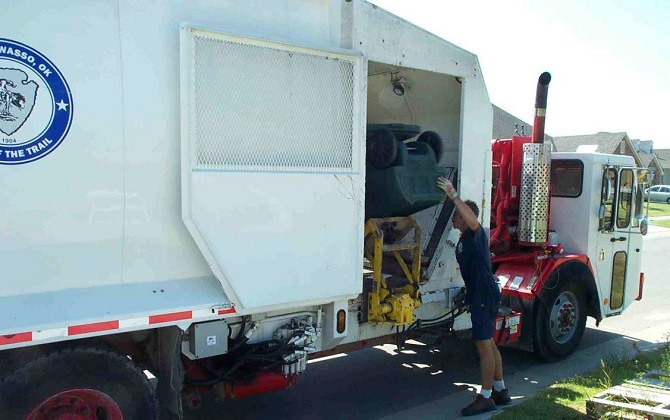
Photo courtesy of the City of Owasso Department of Public Works
With Garbage collectors as a major category of the 3,719,300 material movement workers, as reported by the United States Bureau of Labor Statistics, a new emphasis has been given to understanding today’s garbage trucks and their types. But before anyone can truly understand the developments of the modern garbage truck, readers must look back to the original garbage ‘trucks’ and the need for garbage collection itself.
Brief history
Initially garbage collection was a nominal problem due to growth and spreading of populations. However, the nature of a population is to grow exponentially, making population density a greater factor. As population density rose, the troubles of compounded garbage began to take shape. This effect was only augmented by the rise of cities making populations even more concentrated, concentrating garbage as well. As a result of this accumulation, deadly disease spread rapidly. The most mortal of these diseases include dysentery, cholera, and the infamous bubonic plague. It is remarkable to think that at every moment in modern life sanitation is the only force holding back destructive plagues.
Eventually a garbage collection service was born as early as the eighteenth century. Collectors would walk the streets with an open cart, collecting trash and excrement along the way. This method provided great aid to the issue of dysentery but was still not sterile enough to prevent all diseases. So in the 1920’s Britain developed the covered body cart, allowing garbage to be sealed away while the cart was not being loaded. This development handled nearly all concerns related to disease, but there was a new issue: labor.
Solutions to garbage collection
Garbage collection became a labor intensive job. At one point workers would need to push collected garbage and load garbage into the collector. As a result it became an undesirable and injury-prone duty. In turn the external hopper was developed. Instead of hoisting garbage to the top of the truck, workers became able to drop trash into the waist-height hopper, saving back strain. This theme of labor saving developments would continue until today, but the next focus would be to improve the hopper. The primary problem of the hopper was uneven distribution of garbage into the truck. To resolve this, rotary garbage trucks were attempted, but even distribution compactors were eventually accepted as the norm. By hoisting garbage over the top of the truck, the load can be evenly distributed, solving the problem of balance. Semi-automated side loaders proved to be popular for large apartment complexes, in the second half of the 20th century. The garbage truck would use a lifting mechanism to lift the container and mechanically dump it into the truck. However, the reason why it is semi-automated is because a worker would need to get out of the truck and roll the container to the lifting mechanism.
Today the focus is on speed and efficiency. To this extent, many municipalities have turned to automatic collection trucks. All a truck has to do is pull up beside a garbage bin and a hydraulic system mechanically loads the garbage into the truck, without imposing any manual labor on the workers. This solution allowed time, labor, and tax dollars to be saved. Each garbage collector can handle a larger area, resulting in less money put towards garbage collection. It is truly amazing for us to reflect on how garbage collection has evolved from a team of men pushing carts, to an automatic and automotive collection system, over the past 100 years.
Latest Posts
How Does Composting Help the Environment?
Sustainable School Project Solutions
Enhance Business Efficiency with Waste Collection